
Cassava Autonomous Network takes Africa’s 4G and 5G networks from manual operations toward autonomous networks, accelerated by NVIDIA.
Introduction: Why Network Optimisation Needs Reinvention
Across the world, telecom operators face a stubborn paradox: radio access networks (RANs) are becoming denser and more complex, yet daily optimisation remains largely manual and slow.
The 2026 NVIDIA State of AI in Telecommunications survey (1,038 respondents worldwide across telcos) indicates that 54% of respondents ranked network automation over customer experience as the top AI use case for investment and ROI, underscoring the industry’s shift toward autonomous networks and AI-driven RAN operations.
Routine adjustments such as antenna tilt or transmit power take minutes to apply, but the surrounding workflow — data extraction, correlation, approvals, and post-change verification — can stretch to four days or more.
These inefficiencies translate directly into higher OPEX, SLA exposure, and lost working capital, especially in multi-vendor environments.
Africa’s Distinct Connectivity Landscape
Most African mobile networks are 4G-heavy, multi-vendor, and operate under tight resource constraints, creating a challenging connectivity landscape for African operators:
- ~49% of Africa’s population is covered by 4G (GSMA, 2024)
- 5G is live in 10+ African countries and is projected to reach 340 million connections by 2030 (20% of all mobile lines), but 4G is expected to remain dominant for the remainder of the decade.
- 5G rollouts are largely integrated using a Non-Standalone (NSA) architecture.
- OpenRAN adoption is still emerging, but not mainstream.
Solutions that assume OpenRAN or standalone 5G are difficult to implement at scale today — an AI-driven solution that operates seamlessly across multiple vendors, network generations, and spectrum bands is essential to maximise performance, control costs, and eliminate operational bottlenecks.
Cassava Autonomous Network is an agentic AI platform that leverages NVIDIA AI infrastructure, NVIDIA NIM microservices, and NVIDIA AI Blueprint for telco network configuration to solve these challenges, enabling heterogeneous mobile networks to optimise themselves intelligently and continuously, helping operators move towards autonomous network operations.
Background: From NVIDIA AI Blueprint to Cassava Autonomous Network
NVIDIA AI Blueprint for telco network configuration, is a foundational building block for AI-driven RAN optimisation using GPU acceleration and closed-loop control. Built with NIM microservices, the blueprint implements an agentic-AI workflow that uses historical KPI data to recommend optimal configurations for specific RAN parameters, validate the user’s selected settings, and monitor KPIs after changes.
Additionally, the blueprint leverages the 5G OpenAirInterface platform to enable technology‑agnostic network deployments, making it adaptable to environments where legacy or hybrid RAN systems are common, such as those using a 5G Non‑Standalone (NSA) architecture.
https://build.nvidia.com/nvidia/telco-network-configuration
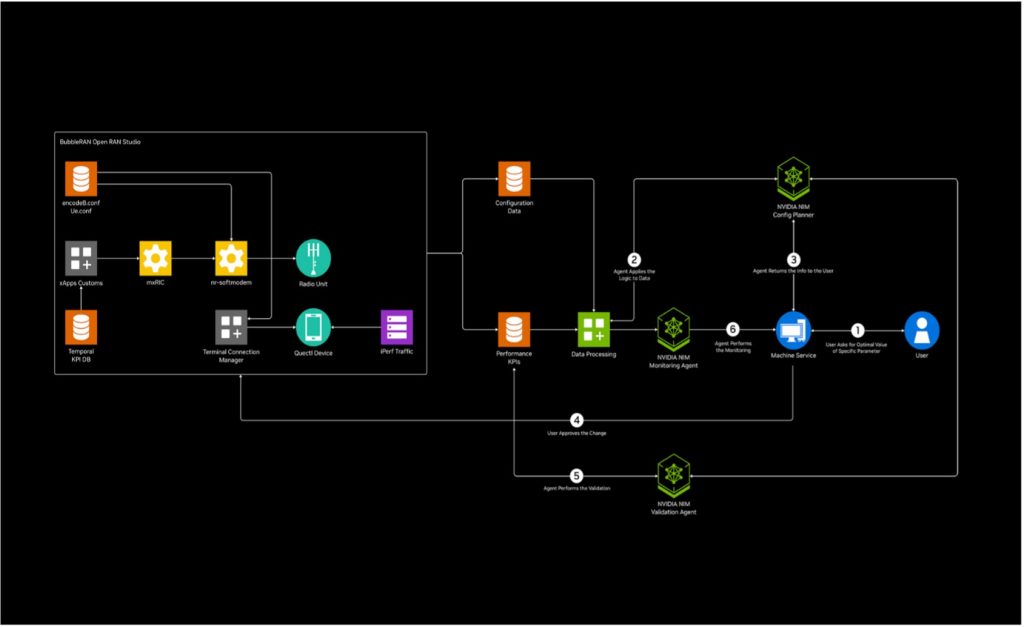
Cassava Autonomous Network extends this blueprint into a production-ready solution built around 3 network agents:
- KPI Monitoring Agent – interfaces with vendor reporting systems to collect KPI measurements, analyse and forecast network performance, and recommend parameter changes.
- Configuration Agent – operates within defined guardrails to autonomously apply and document configurations, or request “human-in-the-loop” approvals for higher impact changes.
- Validation Agent – continuously monitors post-change network performance to determine whether the new configuration meets the operator-defined acceptance criteria or should be automatically rolled back to mitigate negative outcomes.
Across these 3 agents, Cassava Autonomous Network brings AI-powered intelligence and closed-loop optimisation to heterogeneous networks spanning 4G, 5G, and both OpenRAN and traditional RAN architectures, delivering a truly African-ready self-optimising RAN solution.
Solution Overview: Cassava Autonomous Network in Action
Cassava Autonomous Network is an AI-driven, GPU-accelerated platform that continuously analyses, predicts, and optimises radio access network performance, transforming complex RAN operations into a simple, fully automated optimisation loop.
- Data Ingestion & Normalisation — Collects configuration, performance, and alarm data across all vendors.
- Analysis & Correlation — Identifies degradation, interference, and capacity or configuration anomalies in near real time.
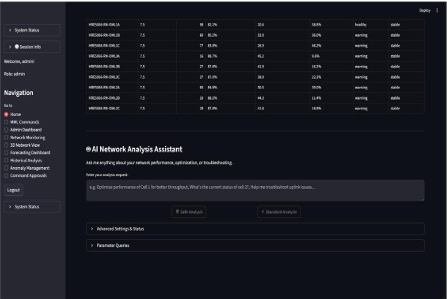
- AI Recommendation Engine — Suggests optimal parameter configurations, such as power and tilt adjustments, evaluated by risk and expected gain.
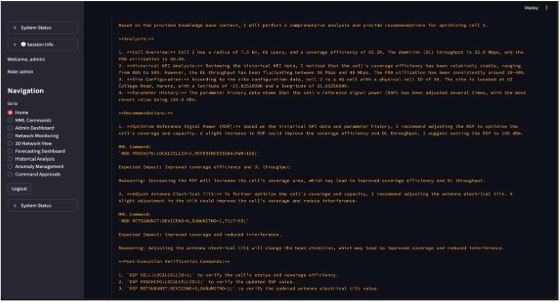
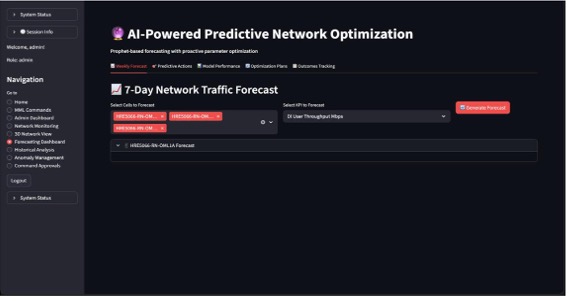
- Forecasting – Predicts future events per cell and suggests configuration changes to maintain optimal network performance.
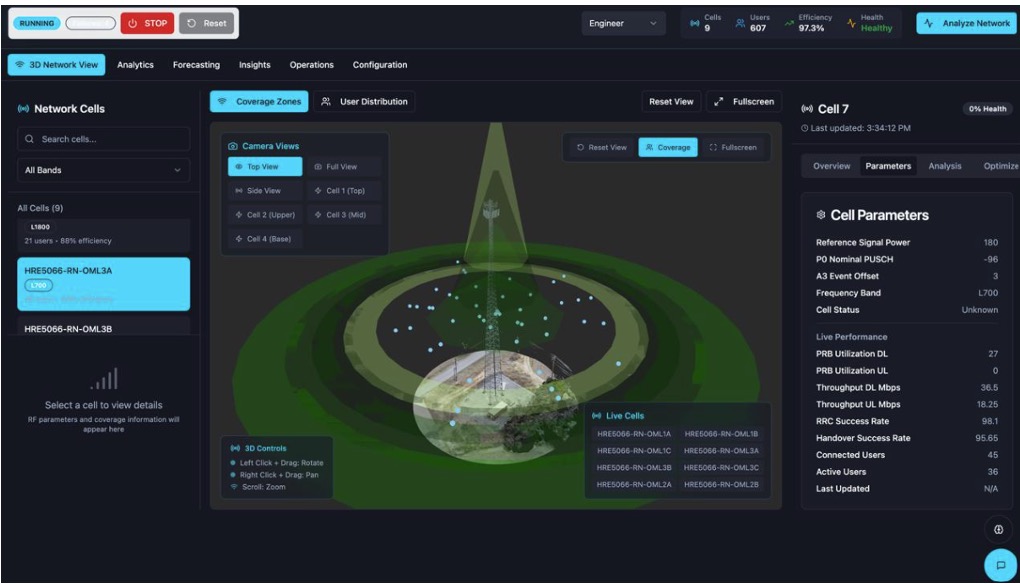
- Real-Time Visualisation – The network can be visualised in 3D format with real-time distribution of connected users to the site and a clear set coverage radius, which aids in intelligent decision-making of the next best action
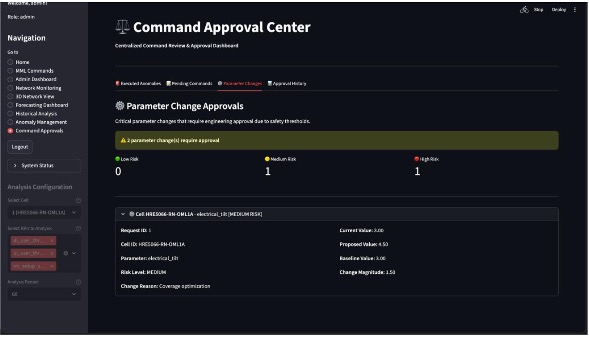
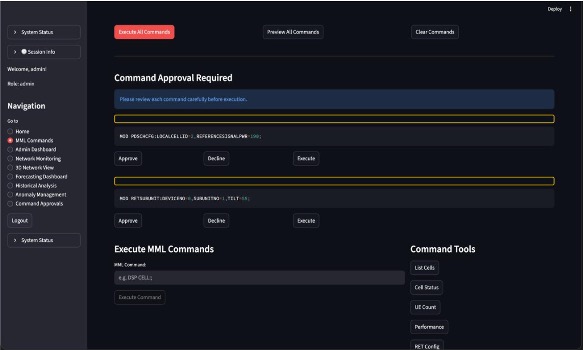
- Validation and Rollback – Performs a post-impact assessment of implemented changes and intelligently decides whether to maintain or roll back the new configuration. Policy Gating & Execution — Automatically executes low-risk actions and flags high-impact ones for manual review, ensuring appropriate human oversight within the workflow
- Audit & Governance Logging — Records every decision, approval, and KPI delta for traceability, enabling explainable AI (XAI).
Bridging Innovation and Operator Value
Cassava Autonomous Network empowers operators to unlock meaningful operational efficiencies and advance towards AI-native full-lifecycle RAN operations. By eliminating manual data processing and embedding intelligence across network configuration, issue-detection, and remediation workflows, operators can better utilise skilled personnel, maintain higher network uptime, and consistently deliver exceptional customer experiences.
For operations teams, this means fewer manual tickets, shorter optimisation cycles and clearer governance around who changed what and why, while for the business it means more performance from existing hardware, fewer SLA risks, and a cleaner path to autonomous networks.
An early deployment of Cassava Autonomous Network on the Econet Zimbabwe Network demonstrates quantifiable efficiency gains:
| Metric | Before Cassava Autonomous Network | After Cassava Autonomous Network | Improvement |
| Optimisation cycle time | 4 days | ~1 day | ≈ 75% faster |
| Approval time (minor) | 2 days | ~10 minutes | > 99% faster |
| Approval time (major) | 30 days | ~5 days | ≈ 85% faster |
| Alarm volume | Baseline | –5% to –10% | Millions fewer alarms/month |
How to adopt Cassava Autonomous Network for your network
- Pilot in a representative cluster (for example, tilt and power optimisation).
- Benchmark current vs. optimised metrics (cycle time, alarms, approvals).
- Enable human-in-loop governance, relaxing automation policies over time.
- Integrate logs into existing change-management and observability systems.
- Scale gradually across regions and vendor domains.
In early pilots, operators have achieved measurable ROI within a single quarter.
Conclusion: Built for Africa, Powered by NVIDIA
Cassava Autonomous Network combines NVIDIA’s AI infrastructure accelerated computing platform and AI blueprint with the inclusivity that Africa’s networks need — working across 4G and 5G, all vendors, and both Open RAN and traditional deployments.
By moving optimisation from human time to machine time, it delivers tangible business and network performance gains.
For African telcos, it’s not just automation — it’s a step toward autonomous, self-healing networks powered by agentic AI that drive improved coverage, service quality, and profitability.
Cassava Autonomous Network: The future of autonomous networks — made real, made scalable, made for Africa.